






RRCC Logo
Enroll Now!! | about us | students | log in | arvada campus | employment
campus directory | A-Z index | search
financial aid photo of money

College Opportunity Fund

Sign up for COF or pay more in tuition!

Download RRCC's brochure and Q&A flier for more information:


What is the College Opportunity Fund and how is it different from state funding now and in the past?

In July of 2004, the College Opportunity Fund (COF) (C.R.S. 23-18-101 through 23-18-207) became law. The legislation (SB 04-189) established a new student-based process for providing state funds to institutions of higher education.

Institutions currently receive funding directly from the State of Colorado in the form of a general fund subsidy to educate in-state higher education students based on a full-time-equivalent student formula.

Starting fall 2005, students will see the amount the state contributes to the college on their behalf and direct the stipend to the institution. Students will be able to monitor the number of credit hours for which their stipend was paid.

What is a stipend?

“Stipend” means the amount of money per credit hour paid by the State of Colorado on behalf of an eligible undergraduate student – Colorado resident with a Social Security number – who is attending a state institution of higher education. The first time an eligible undergraduate student is able to receive a stipend will be for the fall semester of the 2005-2006 academic year.

The Colorado Legislature will set the specified amount of the stipend per credit hour annually. The amount will never exceed the student’s total in-state tuition. The value of the per credit hour stipend will be the same for each eligible undergraduate student, regardless of the state college or university the student attends.

If an eligible undergraduate student attends a participating private college or university in the state of Colorado, the per-credit-hour amount will be 50 percent of the annually set stipend amount. Total stipend hours per student, per semester, are determined by the school and reported to the College Opportunity Fund. COF matches student information with Stipend Application Account information in its database (the information you provide when creating a stipend account) and disburses the stipend amount directly to colleges and universities on behalf of those eligible undergraduate students identified by the school.

When does the College Opportunity Fund take effect?

The College Opportunity Fund will begin July 1, 2005. Continuing students and new students starting school in the fall can sign up now for the stipends. Eligible undergraduates attending fall 2005 semester will be the first program recipients.

Why do I need to set up this account?

COF is a new way to distribute the state funds for college. In the past, the funds were sent directly to the college. With COF, the funds will be sent to the college on behalf of each individual student. Students will be able to see the state’s contribution – their stipend – on their tuition bills. Colorado residents who don’t sign up for COF will have to pay their tuition plus the portion the state would have paid.

How do I sign up for the College Opportunity Fund?

You can sign up for COF online at www.CollegeInColorado.org, or click on the COF link https://cof.college-assist.org.

The process is simple. Type your name, Social Security number and date of birth in the appropriate boxes and click on the “submit” button.

Do I need to sign up for COF every semester?

No. You only have to sign up once, even if you transfer to a
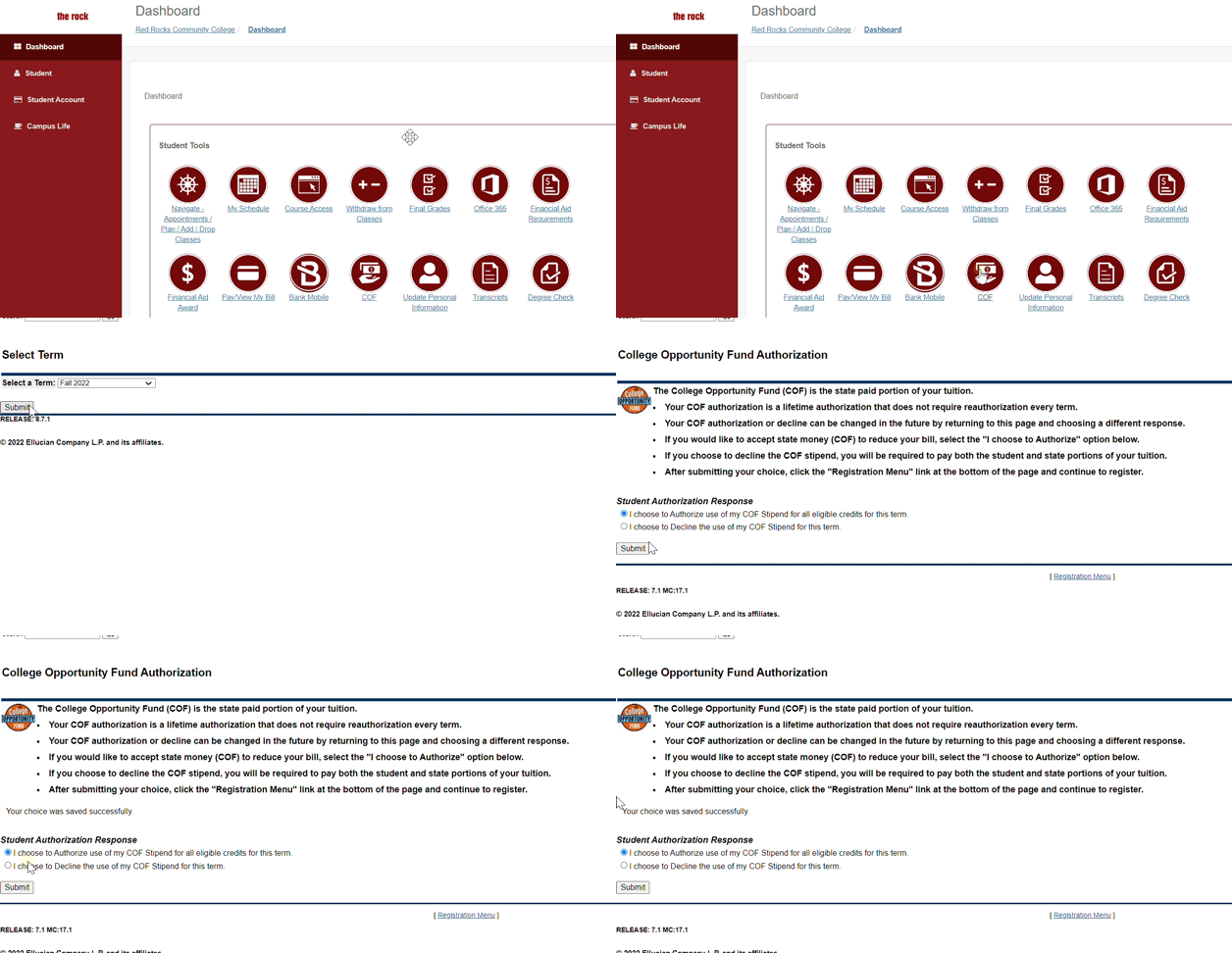
different college. Your stipend will follow you. When you register for classes, you may need to authorize the college to collect money from your stipend.

Who is eligible?

Students classified as in-state for tuition purposes and enrolled at state institutions of higher education are eligible for COF.

Additionally, students enrolled at participating private institutions of higher education may be eligible if the institution is approved for the program by the Colorado Commission on Higher Education (CCHE) and the student:

• is classified as an in-state student for tuition purposes;
• is a graduate of a Colorado high school or has
successfully completed a non-public home-based educational program in Colorado;
• demonstrates financial need through the student’s eligibility for the federal Pell Grant, or its successor program; and
• meets any other eligibility requirements established by the Colorado Commission on Higher Education
(CCHE).

Note: “Eligible Undergraduate Student” does not include students enrolled in an off-campus, extended campus, or continuing education class not supported by state general fund moneys, except as approved by the CCHE.

I am a transfer student, am I eligible for the College Opportunity Fund?

The state will develop a policy to determine the number of credit hours for which continuing and transfer students may receive a stipend from the College Opportunity Fund. All institutions will be required to follow this policy. If you have questions on this, be sure to contact your school or CCHE (303-866-2723).

What if I do not have a Social Security number?

Students must have a Social Security number to sign up for the COF. If they do not have one, they will not be eligible to receive the stipend that covers part of their in-state tuition.

How much is the College Opportunity Fund stipend worth?

It will vary. The per-credit-hour-stipend amount will be determined each year by the Colorado Legislature.

Will the stipend pay for all of my in-state tuition?

No, the stipend only covers an amount set each year by the Legislature. The student still must pay the remainder of in-state tuition. You will need to check with the institution(s) where you plan to enroll to determine what your portion of in-state tuition will be.

What will the College Opportunity Fund pay for? What do I pay?

Your college or university bill will show the amount paid by the College Opportunity Fund and the portion for which you are personally responsible. You will pay the total tuition minus the College Opportunity Fund portion and minus financial aid.

Does the College Opportunity Fund replace financial aid?

Any financial aid you receive will be applied to your share of in-state tuition. The College Opportunity Fund stipend is not a grant and does not affect your eligibility for student financial aid.

Will a check be sent to me?

No, the College Opportunity Fund stipend goes to the institution or institutions where you have enrolled. The stipend will be
applied and noted on your student account.

Do I have to let my institution know that I am attending?

Yes, you need to apply to, be admitted by, register for classes and be authorized as an eligible recipient at each state or participating private institution of higher education where you want to use your College Opportunity Fund stipend.

How many credit hours will be paid for by the stipend?

The law creating the College Opportunity Fund caps a student’s stipend at 145 credit hours. However, there are exceptions and waivers that can be granted by the institution and by CCHE. Institutions and CCHE will develop policies to inform students about the limited waivers, exceptions and how to apply. The law allows CCHE to grant up to an additional 30 hours of undergraduate credit to a bachelor’s degree holder by policy.

You will be able to check, online, to see how many credit hours of the 145 limit that you have used so that you can plan your higher education to best use the stipend. The College Access Network (CAN) – formerly the Colorado Student Loan Program – is administering the fund and student stipends and will maintain the website.

Can I take as many credits as I would like?

No. Credits limits are set according to the student’s status. For example, a freshman student will have 145 credits while a sophomore will have 115 credits. The total number of credits available to students under COF should be enough to earn an associate’s and a bachelor’s degree.

Will the College Opportunity Fund pay for all of my courses?

No. Eligible students may use their stipends only for college-level undergraduate courses. The following courses will NOT be paid for by the College Opportunity Fund:

• basic skills;
• “Postsecondary Enrollment Options Act” courses;
• high school Fast-Track courses;
• international baccalaureate courses;
• advanced placement courses; and
• graduate courses.

What if I go over the 145-hour cap? Whom should I talk with and what is the process?

If you go over your 145-hour lifetime-credit-hour cap, you may apply to CCHE for a waiver. The law allows for CCHE to grant waivers to a student if:

• there are extenuating circumstances related to the student’s health or physical ability that restrict a student’s ability to complete the degree program within the 145-credit-hour limit;
• the degree program, as approved by an institution or CCHE, requires more hours to complete than the 145 credit-hour limit allows;
• the student is enrolled in a specific degree program that CCHE approves and the institution changes that program’s degree requirements or standards; or
• requiring that an eligible undergraduate student pay the full amount of total in-state tuition for credit hours that exceed the limitation causes substantial economic hardship for the student or the student’s family.

What can I do to be sure I am using my credits wisely?

A degree plan will help you outline the classes you will need to earn a degree or certificate in the shortest amount of time and with the least number of credits. Because COF limits the number of credits you can take, you will need to meet regularly with an adviser or case manager to be sure you are on the right track.

Can I attend more than one institution and receive the College Opportunity Fund stipend at each institution that I attend?

Yes, but you need to apply to, be admitted by and register at each eligible institution you want to attend. Each institution then must verify your enrollment and the number of credit hours you are taking there. You – the student – must indicate on your college application that you are seeking payment of the stipend to multiple institutions. The hours taken at each institution count against your maximum number of hours –145 – that the College Opportunity Fund covers.

What happens if I am not able to complete a course that is paid by the stipend?

The stipend amount applying to your tuition bill is not refundable if you withdraw from or fail a course.

top

COF Logo

Questions?


Email: COF@rrcc.edu


720.264.8550
or
1.800.777.2757

or contact:
Jennifer Panetta
COF Advisor
303.914.6254