The Dream Was Always Calculus — In a Hawaiian Shirt
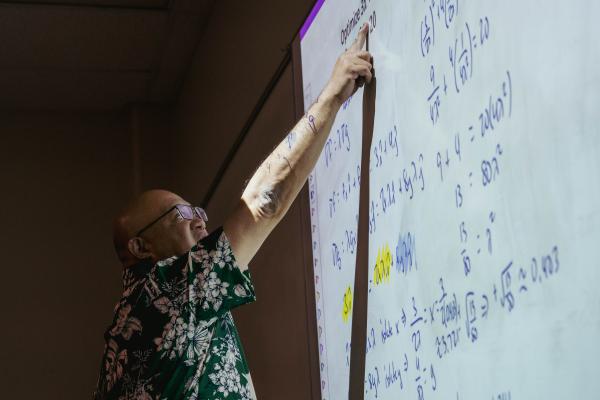
In Melvin Cacayorin’s math classes, students work on group projects, might learn about coding, the theory and the history behind math topics and even hear about how to pick a hobby.
It’s all part of how Melvin shows students his passion for math, and how much he cares about them.
“I want to be as broad as I can,” Melvin said. “I don’t like to do just calculus 3 because it’s much bigger than this. Students will relate to some aspect of it so they can succeed.”
Melvin has been working on research about math anxiety in the last couple of years. He summarizes it saying that it’s like any other anxiety stemming from fear of failure and fear of the unknown. And he believes any student can overcome those feelings regardless of their past experiences with math.
“We can help them change their habits. We just have to give them pathways, even a small idea of how to change,” Melvin said.
He’s been invited to present his math research at conferences and is going to another one next month – presenting at the national American Mathematical Association of Two-Year Colleges in Philadelphia.
“I tell the students you can do this, you can do anything, you have the growth mindset,” Melvin said.
Getting more context about all to do with math and understanding how it relates to your world is one way that the unknown becomes less scary.
But he also found that using projects more than quizzes helps relieve student anxiety, for two reasons. First, because students feel less time pressure with projects. More importantly, when he makes students form into groups, they learn to approach the work together.
“They can face failure together and it’s less scary, then it becomes a community that succeeds,” Melvin said. “They rise up together.”
In one example, he said he had a group of six students that ended up enrolling together in calculus 1, 2, and then 3 to continue helping each other through. Then he learned, they all transferred to CU Boulder together where they’re still helping each other out.
And helping students think about self-care is just as important, Melvin says.
“I had a student last week hit a wall, just needed help,” Melvin said. “I asked, what do you do for self-care? We’re in a world where we’re driven to work 24/7. Sometimes they don’t believe me but you have to take a break, reset, then you can move more efficiently. I learned that in graduate school. I also didn’t believe it until I tried it.”
So, Melvin talks to students about the importance of finding things that are: positive, profitable, and productive – but also legal.
He shares how he enjoys fishing.
“I like to tell stories,” Melvin said. “Right now, everyone knows about my fishing – it’s horrible! I got my license for $47 and I’ve caught three fish.”

But he laughs about it and tells students that it’s still a relatively cheap hobby that helps him relax, reset, and then move forward.
And his fishing passion shows up in tests. Students recognize “Trey the Tilapia” as a common character in Melvin’s math problems.
Melvin’s love of fishing and being on the water might relate to being in a landlocked state after having been born in Hawaii.
His family migrated to the island from the Philippines in the late 60s after his grandfather had gotten to know the island while working on the pineapple and sugar cane fields.
Melvin was born in Wahiawa, which is in central Oahu.
He left the island to study in South Carolina and now has been in Colorado since 1999. He’s married and has three children. He said all three have been identified as autistic, and it has only contributed more to his enthusiasm for helping students with various needs.
He says he studied math because he felt it was the only field he could tolerate. He went into it not sure about what career it could lead him to.
When he started teaching, the plan was that it would be for just one year.
But he says he doesn’t really like change and so he let one year turn into 10, and now more than 20. He first started teaching at Red Rocks as an adjunct instructor in 2016 and became full-time in 2023.
Reflecting on Filipino American History Month celebrated in October, Melvin says he is not in a stereotypical profession for Filipinos, and his approach that involves relaxing, sometimes contradicts messages he heard growing up that could equate relaxation with laziness which needed to be avoided at all costs.
But, he says, he wants people to know that he strives to be generous and hardworking.
“It’s a heritage,” Melvin said. “Filipinos are some of the most generous people you’ll meet. I hope to be the hardest working. And I try to be one of those generous people.”
Several of his students do describe him as generous, caring and kind.
Before he taught college students, Melvin taught high school students. But in college, Melvin loves being able to teach advanced math.
“If I could teach calculus 1, 2 and 3, that would be the dream – and in a Hawaiian shirt,” Melvin said. “And I did. Nothing’s better than this.”