What class will get you there?
Nov. 23, 2026 | By Yesenia Robles, RRCC, MarCom
Usually, fire and wood don’t mix.
But this semester, students studying carpentry and construction technology had the opportunity to work on a project that gave them real-world experience — and helped future firefighters.
The project brought together two RRCC programs in a way that gave students in each real, practical experience.
“It’s been a good example of what work-based learning looks like at RRCC,” said Chris Madsen, Director of the Skilled Trades programs.
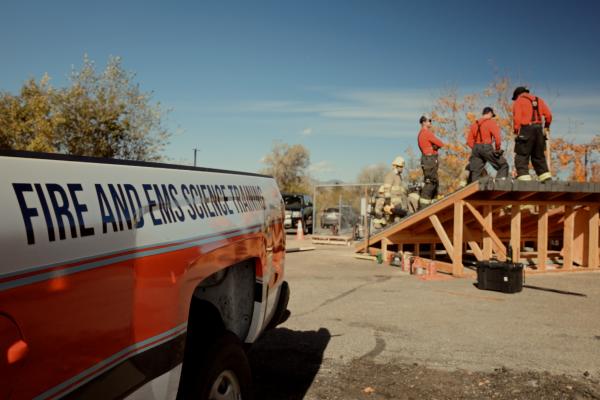
The idea started with the fire academy leader. Steven Gillespie (Steve), the Faculty Department Chair for Fire and Outdoor Studies, said his program needed a prop for an important part of the firefighting training program.
RRCC’s fire academy, which prepares students to earn their state firefighter’s license, moved entirely to the Lakewood campus, last year. The first year, the program was able to make use of an abandoned mobile classroom trailer on the campus, but that structure was demolished before the semester began.
That meant the fire academy needed new props to train students how to properly vent roofs – a crucial firefighting technique that is required for state licensing. Venting roofs during a fire helps increase visibility while firefighters are searching for victims trapped in a burning structure. So, Steve went to Chris and asked if a simple simulated roof was something that the carpentry and construction students could build. It presented an opportunity for the kind of real-world experience that RRCC is always looking to offer.
The construction technology class looked at the examples Steve provided and made their own blueprints. Steve got to be a real client who gave students feedback and asked questions.
Scott Hayzlett, an instructor for the construction and carpentry courses, said the project was a great fit for his course.
“We were able to get students to engage with a real-world project that was going to be used,” Scott said. “It was really fun.”
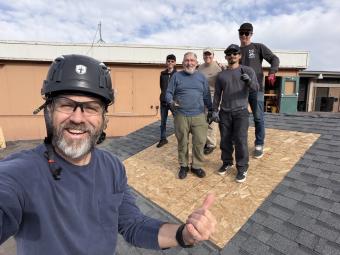
Once the design was approved, students put together a list of materials needed so Steve could buy them.
Students in a roofing framing class started the build one weekend, while a roofing fundamentals class finished the project on another weekend in October. Some students were able to use new tools they hadn't tried out before.
In early November, fire academy students spent three days rotating through practice on the new prop.
They had just learned how to use a chainsaw and took the lessons on ventilating roofs out onto the student-built roof.
Wearing full gear, fire academy students walked up the slope of the roof in pairs and took turns finding the right place to cut. Using a chainsaw, they made square openings and punched through the structure so that smoke could escape.
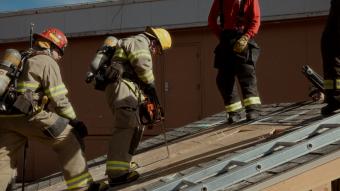
Fire Academy students training at the RRCC Lakewood campus. Photos by Trevor French, RRCC, MarCom.
After each cut, instructors simply slid in a new piece of plywood – it was all part of the design – and the next pair of students got their turn.
Firefighting jobs are highly competitive, but the RRCC program designs courses to give students transferable skills, like roof venting.
Tony Martinez, one of the academy instructors, and graduate of the RRCC fire academy, now works with the Denver Fire Department.
“It’s not just, this is what this area focuses on, it’s how do we set them up for success,” Tony said. “This gives them a competitive edge.”
Some of the carpentry and roofing students commented that it was great to apply their knowledge on a real project, and work with tools that were new to some of them. Others told instructors that it was great to know they were working on something meaningful.
Steve thanked the construction and carpentry students and emphasized just how important the project was for his firefighter students.
“One day there’s going to be a firefighter on a real fire cutting a roof and that’s going to make that one bit of difference,” Steve said. “You’ll never know it, but five, 10,15 years later you’ll have had a hand at some point in that 2-year-old being rescued out of a building.”